
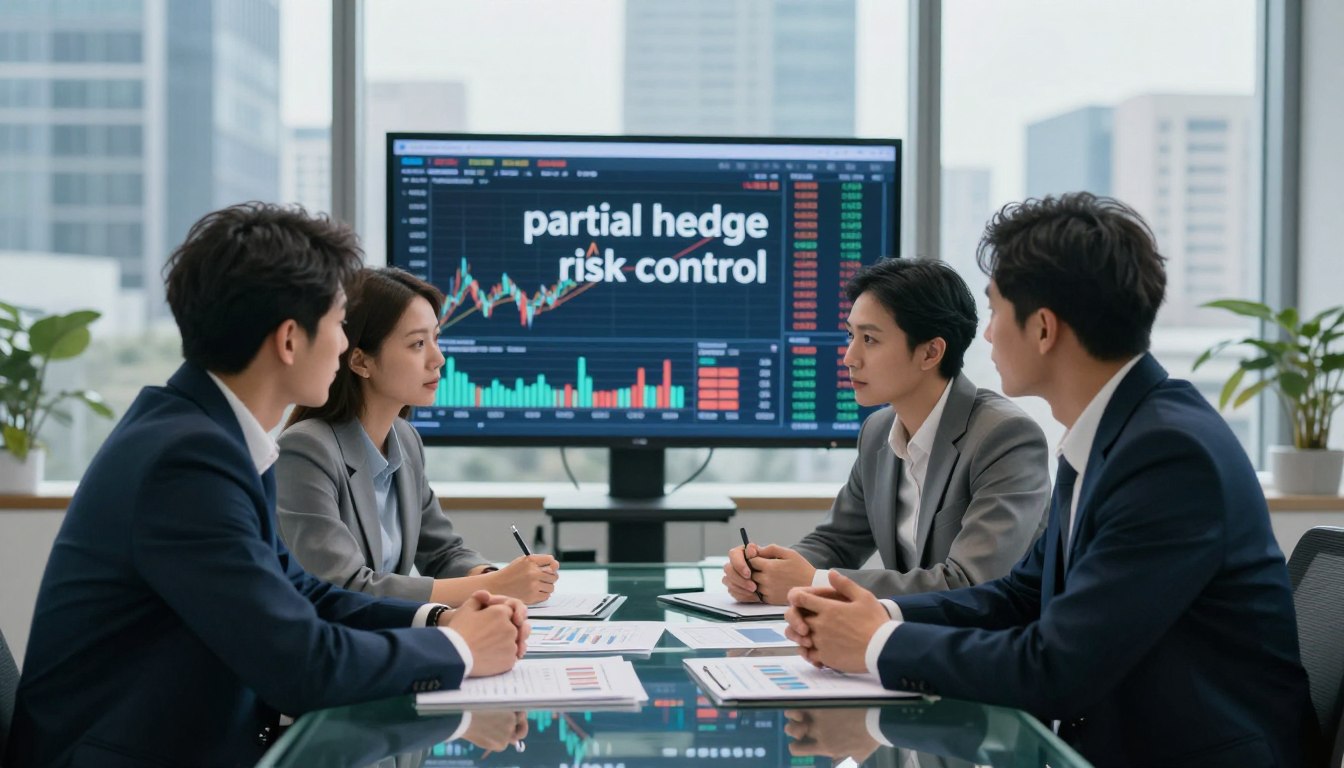
Think of a hedge like financial insurance for your investments. You pay a known, smaller cost—like an option premium—to guard against a larger, unexpected loss. This risk management strategy uses tools like options and futures to offset possible downturns.
The goal isn’t to hit a home run. It’s to protect what you have. A smart partial hedge can add clear value by shielding you from severe downside. In other cases, simply accepting market volatility is the better move.
You always face a trade-off. More protection usually means less possible profit. Your time horizon and risk tolerance decide if this risk control is a wise play or an unnecessary expense.
From currency moves affecting your international stocks to guarding a single investment, the core idea stays the same. It’s about making a deliberate choice to manage uncertainty, just like you would with any important insurance decision.
Partial vs. Full Hedges
Think of hedging as a dimmer, not a light switch. It lets you adjust how much protection you get on your investments. You don’t have to choose all or nothing.
The main settings are the partial hedge and the full hedge. Your choice depends on your budget, how scared you are, and what you want to achieve.
A full hedge aims to remove a specific risk completely. For example, a U.S. investor buying European stocks might fear the euro’s fall against the dollar. A currency-hedged ETF can remove this risk.
Locking in the price of oil for a year is also a full hedge. It gives you total price certainty.
A partial hedge is more flexible. It only covers part of your risk. This balances cost with protection. If you own 100 shares of a stock and fear a short-term pullback, you might buy put options for 50 shares. This cuts your risk in half for less cost.
This approach is common with bonds or short-term investments. Currency swings can quickly erase small returns. A partial hedge can protect those returns without giving up all upside.
| Feature | Partial Hedge | Full Hedge |
|---|---|---|
| Primary Goal | Reduce risk to a manageable level | Eliminate a specific risk entirely |
| Cost | Lower upfront cost | Higher upfront cost |
| Upside | Retained for the unhedged portion | Typically sacrificed for certainty |
| Best For | Investors with a moderate view or limited hedging budget | Absolute risk aversion or precise cash flow needs |
How do you choose? Start by asking three questions.
First, how strong is your conviction? If you’re very nervous, a larger hedge makes sense. Second, what’s your budget? Tools like forward contracts have costs based on interest rate differences. A full hedge is more expensive.
Third, what’s your main goal? Is it to sleep better at night? Or is it to protect a specific profit target? For example, an early settlement of a contract might use a full hedge to lock in a guaranteed price.
In many cases, a partial hedge offers the best balance. It acts like insurance with a deductible. You cover the big loss but handle smaller dips yourself. This strategy is a core tool for active risk management, distinct from a more defensive short hedge position.
Calibrating your hedge size is a personal finance skill. It matches your protection to your fear and wallet.
Cash‑Out Pricing and Hidden Costs
Every strategy for risk control has its own costs. When you buy insurance for your portfolio, you’re paying for protection. But the price isn’t always clear on your statement.
The most obvious cost is the option premium. You pay cash upfront for a put option, and that money is gone whether you use the hedge or not. Other costs are hidden in the product itself.
Hedged ETFs charge management fees. They also deal with the bid-ask spread when adjusting currency positions. Futures and forward contracts have an implied cost based on interest rate differences between countries.
| Type of Hedge | Visible Cost | Hidden Cost | Impact on Early Exit |
|---|---|---|---|
| Put Option | Premium paid at purchase | Potential time decay if held | May only recoup intrinsic value |
| Hedged ETF | Annual management fee (MER) | Tracking error, currency roll costs | Bid-ask spread on sale, embedded lag |
| Futures Contract | Commission to broker | Implied financing cost (carry) | Settlement at a potentially unfavorable future price |

Trying to exit can be a surprise. This is called early settlement or de-hedging. You might think cashing out is just the reverse of getting in. But the price you get can be different from the live market move.
This mismatch is tracking error. The hedge product didn’t perfectly follow the asset it was supposed to protect. You pay for this imperfection. It’s a hidden fee for imperfect protection.
A real example is the iShares Core S&P 500 Hedged ETF (XSP). It aims to give U.S. stock returns to Canadian investors, minus Canadian dollar swings. Historically, during periods of sharp Canadian dollar strength, the ETF’s hedge didn’t fully deliver the expected buffer.
The management fees and operational costs of constantly rolling currency forwards ate into the benefit. The hedge had a cost that wasn’t clear from the headline returns.
Before you hedge, ask these questions: What is the total cost, including all fees and spreads? What happens if I need to close this position early? How has this product performed during past market stress? Understanding these costs is a key part of responsible financial management and true risk control.
Step‑By‑Step Examples
We’ll now break down three common hedging situations. We’ll walk through the decision process and math for each. This turns abstract concepts into actionable plans. Think of it like locking in odds before a big game—you’re securing a known outcome instead of leaving it to chance. For more on the language of locking in value, you can explore common betting terms.

A farmer plants wheat in spring, facing a major risk: grain prices could crash by fall. To hedge, they don’t wait for harvest.
- 1. Identify the Risk: Exposure to a drop in the cash price of wheat at harvest time.
- 2. Select the Instrument: Sell wheat futures contracts for delivery in the harvest month. This locks in a sale price today.
- 3. Execute the Trade: In April, the farmer sells December wheat futures at $6.50 per bushel for their expected crop.
- 4. Analyze the Outcome:
- Scenario A (Price Falls): Come December, the cash price is $5.50. The farmer sells their physical wheat at this lower price but profits $1.00 per bushel from their futures position, netting the effective $6.50 they locked in.
- Scenario B (Price Rises): The cash price jumps to $7.50. The farmer sells their wheat high but loses $1.00 on the futures contract. Their net is $6.50. They gave up extra profit for price certainty.
The breakeven is the initial futures price of $6.50. The farmer could also opt for an early settlement by buying back the futures contract before harvest if their view on prices changes.
Example 2: The Investor’s Protective Put (A Partial Hedge)
An investor owns 100 shares of Cory’s Tequila Corp (CTC), trading at $50. They’re bullish long-term but fear a short-term correction.
- 1. Identify the Risk: A sudden drop in CTC’s stock price.
- 2. Select the Instrument: Buy a put option—a right to sell CTC at a set price. This is a classic partial hedge; it protects only the shares owned.
- 3. Execute the Trade: They buy one put option (100 shares) with a $45 strike price, expiring in 3 months, for a premium of $2 per share ($200 total).
- 4. Analyze the Outcome: The table below shows the net portfolio value in different scenarios at option expiry.
| Market Scenario | Stock Price at Expiry | Gain/Loss on Stock | Gain/Loss on Put Option | Net Portfolio Value |
|---|---|---|---|---|
| Price Plummets | $40 | -$1,000 | +$500 (Intrinsic Value: $45-$40=$5, minus $2 cost) | $4,300 (Est. Floor) |
| Price Stays Flat | $50 | $0 | -$200 (Put expires worthless) | $4,800 |
| Price Soars | $65 | +$1,500 | -$200 (Put expires worthless) | $6,300 (Less $200 cost) |
The put establishes a floor near $4,300 ($45 strike x 100 shares, minus the $200 premium paid). The investor participates in most of the upside, minus the option’s cost. This partial hedge balances protection with opportunity.
Example 3: The Traveler’s Currency Forward
A Canadian plans a €5,000 trip to Europe in six months. The risk is the Canadian dollar (CAD) weakening, making euros more expensive.
- 1. Identify the Risk: Exposure to a rising EUR/CAD exchange rate.
- 2. Select the Instrument: A forward contract with a bank to buy euros at a fixed rate today for future delivery.
- 3. Execute the Trade: Today, EUR/CAD = 1.45. The traveler locks in this rate for a transaction in 6 months.
- 4. Analyze the Outcome:
- Scenario A (CAD Weakens): In 6 months, the spot rate is 1.55. By locking in 1.45, the traveler saves CAD 500 (€5,000 * (1.55 – 1.45)).
- Scenario B (CAD Strengthens): The spot rate falls to 1.38. The traveler must buy at 1.45, “losing” CAD 350 versus the spot market. They paid a premium for budget certainty.
The breakeven is the forward rate of 1.45. The traveler’s cost in CAD is perfectly known: €5,000 * 1.45 = CAD 7,250.
These examples show the mechanics of locking in prices and setting floors. Whether you’re a farmer, investor, or traveler, the process is the same: identify your exposure, choose your tool, and execute. Remember, tools like futures allow for early settlement if your plans change, adding flexibility to your strategy.
Common Mistakes to Avoid
Many investors make simple errors that hurt their hedging goals. A common mistake is hedging out of fear. Trying to time currency markets can backfire, ignoring a key risk control principle.
Procedural errors can also be costly. Starting a hedge without a clear plan to end it can leave you exposed. This is true for both full and partial hedges. Always define your exit conditions before starting.
Analytical mistakes can surprise you too. Hedging does not always reduce portfolio volatility. For a Canadian investor holding U.S. stocks, currency hedging might sometimes increase it. Overlooking the total costs, from ETF fees to swap spreads, can also erase any benefit.
Hedging is for protection, not profit. Avoid imperfect hedges that don’t match your actual exposure. Stay disciplined with your long-term plan. Good risk control means making intentional choices, not just adding complexity.
Leave a Reply