

Gone are the days of relying solely on a gut feeling. The world of sports wagering has evolved into a data-driven arena.
Today, success hinges on understanding numbers and trends. This is true for player props, where individual performance is key.
A flood of sports statistics and the rise of analytical tools have changed the game. These resources make sophisticated insights available to everyone.
Platforms now offer AI-powered projections and track line movement in real time. This allows you to spot value before the market adjusts.
Best of all, many of these powerful free tools for research are just a click away. You can experiment and learn without a major upfront cost.
This shift means anyone can move beyond instinct. You can build a strategy grounded in clear information.
Mastering a few core metrics and processes is the first step. It’s the foundation for making smarter, more consistent decisions in understanding NFL betting markets and beyond.
The journey starts with learning how to interpret the data. From there, finding your edge becomes a matter of simple inputs.
What Drives Props (Volume, Efficiency, Minutes)
Every point total or rebound line is based on a simple formula. It involves a player’s volume, efficiency, and minutes played. These three elements are key to any player props analysis. They help you move from guessing to making informed bets.
Think of them as the main ingredients in a recipe. Changing one ingredient changes the whole dish. Advanced models use data on these factors. But the logic is simple.
Volume: The Raw Number of Chances
Volume is about opportunities. In basketball, it’s about shot attempts. In football, it’s carries or targets. For a hockey goalie, it’s shots faced. This is the “how many” part of the equation.
A player’s usage rate is important here. It shows how often they’re involved in plays. High usage means more chances. Recent games show if that chance is increasing or decreasing.
For example, a star NBA guard with a 30% usage rate will likely shoot 20+ times. If his prop is set at 24.5 points, check his recent shot attempts first.
Efficiency: The Success Rate Per Chance
Efficiency is about success rate. It’s the shooting percentage, yards per carry, or completion percentage. A player can have many chances but fail if they’re not efficient.
Season averages are a starting point. But recent performance is key. A baseball slugger in a hot streak will hit home runs more easily. This means he needs fewer at-bats to hit a prop.
Efficiency and volume work together. A player who’s efficient might need fewer chances to hit a total. A player with high volume but low efficiency might hit it through sheer attempts.

Playing time is the biggest limit. No matter the volume or efficiency, a player can’t score if they’re not playing. Projected minutes are critical.
Context is everything here. Is the player in a back-to-back game? Is it a blowout risk? Is there an injured teammate, giving them more time? A sixth man might average 25 minutes, but a starter’s injury could increase their time to 35.
In soccer, a striker subbed off at the 60th minute has a hard ceiling on goals. In fantasy or prop terms, minutes directly cap the possible volume. Always check lineups and news.
| Driver | Sport Example | Key Metric | Impact on Prop Line |
|---|---|---|---|
| Volume | NBA (Shooting Guard) | Field Goal Attempts, Usage Rate | More attempts increase the probability of hitting Over on points. |
| Efficiency | NFL (Quarterback) | Completion %, Yards per Attempt | Higher efficiency means the same volume yields more passing yards. |
| Minutes | NHL (Goalie) | Time on Ice, Confirmed Starter | If a goalie isn’t starting, saves and goals against props are void. |
These three drivers interact constantly. Projected minutes set the ceiling for volume. Efficiency determines how much volume is needed to reach a total. A sharp bettor weighs all three.
By focusing on volume, efficiency, and minutes, you build a solid foundation. This logic applies to any sport. It turns raw stats into a clear picture for your player props decisions.
Create a Basic Projection in a Spreadsheet
Learning to build projections manually helps you understand the link between volume, efficiency, and playing time. This hands-on approach is key to smart betting. You get to see how numbers work together.
Professional models rely on advanced stats. Your goal is to learn the basic formula. This knowledge turns you into an active analyst, not just a passive bettor.
Begin with a blank spreadsheet. Create three main columns. These will hold your inputs from the last section.
- Volume: Attempts per game (shots, carries, passes).
- Efficiency: Success rate on those attempts (FG%, YPC, completion %).
- Minutes: Expected playing time.
Get these averages from trusted sports stats websites. Use the last 10-15 games for a stable trend. Avoid full-season numbers if a player’s role has changed recently.
Your fourth column is the raw projection. This is where the magic happens. The basic formula is simple:
Volume × Efficiency = Raw Output
For points, multiply field goal attempts by shooting percentage. Then multiply by two (or three for three-pointers). Add free throw projections separately.
For yards, multiply carries by yards per carry. This gives you a raw yardage forecast.
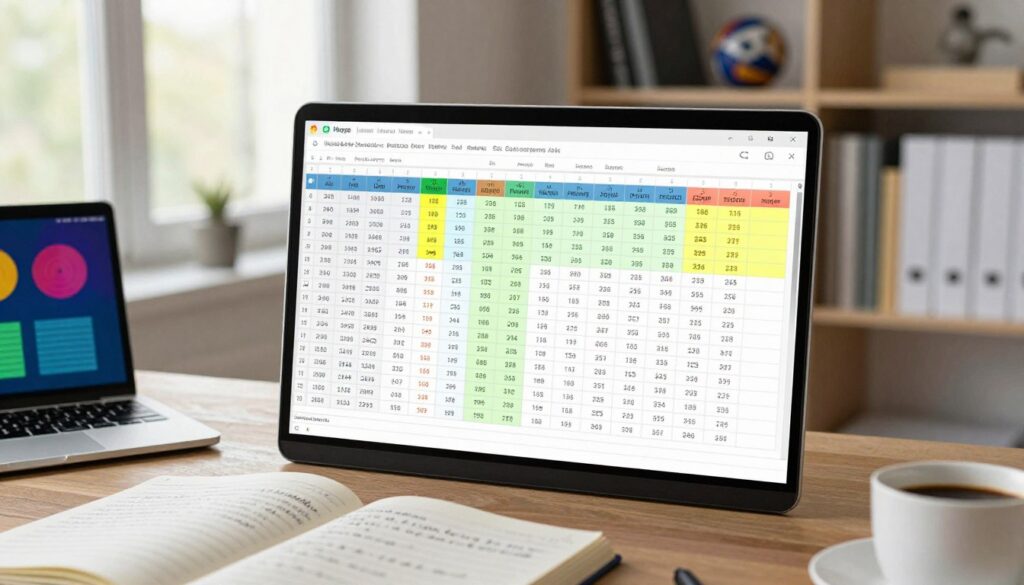
Your final step is the minutes adjustment. A player projected for 30 minutes won’t produce the same as in 40 minutes. Multiply your raw output by (Projected Minutes / Average Minutes).
This table shows a clear example for an NBA player:
| Player | Stat | Volume Avg | Efficiency Rate | Minutes Proj | Raw Projection |
|---|---|---|---|---|---|
| J. Smith | Points | 15 FGA | 48.0% FG | 32 | 23.0 |
| J. Smith | Rebounds | 8.5 Reb Opp. | 12% Reb Rate | 32 | 10.2 |
| A. Davis | Assists | 45 Passes | 18% Ast Rate | 28 | 7.6 |
| M. Jones | Rushing Yds | 18 Carries | 4.2 YPC | Full Game | 75.6 |
These projections are your starting point. They ignore specific defenses, injuries, or motivation. That’s okay. This model is your foundation.
Building it yourself reveals what drives a stat line. You see why a small dip in minutes can crater a rebound projection. You learn how sensitive an efficiency rate is to variance.
This simple spreadsheet is more valuable than a complex AI output you don’t understand. It makes you think about each input. The complex projections from betting sites use this same logic but add hundreds of layers.
Your simple model gives you a line in the sand. You now have a quantitative reason for your bet. In the next section, we’ll refine these raw projections. We will add important adjustments for real-world factors.
Injury/Role/Rest Adjustments
Injuries, rest, and role changes can change a good bet into a bad one quickly. Your spreadsheet gives you a starting point, but it can’t handle news. You need to add real-world context to your analysis.
This step is key to avoid making mistakes. It helps you go from guessing to being a pro at player props.
Changes in a player’s situation can greatly affect their performance. This is true for both how much they play and how well they do.
Key Contextual Factors to Monitor
Before making a bet, check several important areas. Think of it like a pre-flight checklist.
- Injury Reports: Is a player’s status uncertain? Are they playing with a minutes limit? A limit can greatly reduce their stats.
- Role Changes: Has a teammate’s injury led to a new starter? Are there hints of a lineup change? More touches mean more chances to score.
- Rest & Travel: Is the team tired from back-to-back games? Did they have a long flight? Fatigue can lower performance.
- Matchup Context: The qualitative side is important. Is a key defender out? Is the game pace fast or slow?
Start with your spreadsheet’s projection. Then, adjust it based on the latest news.
For instance, if a key guard is out, the backup might score 20-30% more. If a center is tired, their rebounding might be less.
Building a Systematic Process
Successful bettors don’t guess. They have a routine.
Before the game, check injury reports and travel news. Listen to coaches for hints on lineups.
Adjust your model based on this information. This is where you find real player props edges. The market often doesn’t catch up with news fast enough.
By considering injuries, roles, and rest, you improve your analysis. Your projections will become more accurate and useful.
Comparing to Market Lines
Finding a betting edge means spotting a gap between your forecast and the sportsbook’s line. Your work on player minutes and efficiency is just the start. The real choice comes next.
An edge is when your forecast doesn’t match the market’s. Sportsbooks set lines to include their profit margin. You need to turn their odds into an implied probability. Then, compare it to your own projections.
For example, a book might offer -110 odds for both over and under. This implies a 52.38% chance for either side. If your model predicts a 58% chance for the “over,” you have an edge. This gap is where you find profitable bets.
Never bet at the first book you see. Line shopping is essential. Different sportsbooks have slightly different lines. A small change in a points prop or odds can greatly affect your profit.
Your final projections, adjusted for role, rest, and minutes, are your target. Then, check various books to find the best line that matches your forecast. This simple step can increase your profit.
| Player Prop | Your Projection | Sportsbook Line | Implied Probability | Your Edge |
|---|---|---|---|---|
| LeBron James Points | 26.5 | Over 25.5 (-115) | 53.5% | +3.2% |
| Stephen Curry Assists | 5.8 | Under 6.5 (+100) | 50.0% | +4.5% |
| Nikola Jokic Rebounds | 12.2 | Over 11.5 (-130) | 56.5% | -1.8% |
The table shows a clear example. For LeBron’s points, your projection of 26.5 is above the book’s line of 25.5. The odds of -115 imply a 53.5% chance. If you believe the true chance is higher, you have a positive edge. The Jokic row shows a negative edge, signaling a bet to avoid.
This process of comparing projections leads to positive expected value (+EV) opportunities. A +EV bet means you expect to win money over time, even if the single bet loses. Tools like Prop Professor’s Plus EV Tool automate this math, but understanding it is key.
Your final step is simple. If your projection is higher than the line, bet the over. If it’s lower, bet the under. But only do so after confirming a positive edge through line shopping and probability comparison. This disciplined approach turns data into dollars.
Tracking Accuracy Over Time
Your work on player props doesn’t stop after you place a bet. To make consistent profits, keep refining your analysis.
Keep a close eye on how your predictions match up against real game results. Note when your guesses were right and when they weren’t.
This review is your feedback loop. Was a projection off because an injury adjustment was too little? Did a lineup change change the expected volume? Tools like those in sports betting analytics guides can help track this.
Use this data to make your future models better. If your minute projections for certain players are often too high, change your approach. Tracking accuracy sharpens your edge.
This careful review of your player props is key to long-term growth. It turns your guesses into a reliable system.
Leave a Reply