

What’s the most important habit for a winning sports bettor? It’s comparing betting odds across different sportsbooks before betting.
It’s like checking prices on Amazon, Walmart, and Target before buying a TV. Smart shoppers never overpay. Smart bettors shouldn’t either.
This strategy is not just a tip. It’s a non-negotiable core strategy for serious bettors. The small price differences add up over many bets.
We’ll show you how to master this skill. You’ll learn the theory, the best tools, and how to apply them. We’ll also cover advanced tips.
To begin, knowing how to read different odds formats is key. It helps you make a good odds comparison and find real value.
How Vigorish/Juice Works
Vigorish is like a service fee on every bet. It’s called juice and is how sportsbooks make money. It’s hidden in the odds you see.
This fee is like shipping and handling on online shopping. You might get a good deal, but the shipping can ruin it. In betting, the juice is that extra cost, affecting your win.
The standard point spread bet at -110 is a good example. You risk $110 to win $100. The extra $10 is the sportsbook’s commission.
- It implies each side has about a 52.4% chance to win (the implied probability).
- Add both sides together, and you get 104.8%.
- That extra 4.8% is the book’s “hold” or “overround”—their built-in profit margin.
This system works for the bookmaker regardless of the game’s outcome. For a deeper dive into this fundamental concept, learn more about what is the vigorish.
Line shopping is very powerful. Finding the same point spread at -105 instead of -110 cuts down the juice you pay. You now risk only $105 to win $100. This small change greatly improves your odds and profit.
Understanding this commission is key to being a better bettor. Knowing how to spot and reduce the juice gives you a financial edge.
Why One‑Tenth of a Point Matters
Many bettors ignore small line changes, but smart shoppers see their value. In sports betting, tiny differences can make a big difference. It’s like finding the best deal at the grocery store.
Imagine the NFL spread difference between sportsbooks is not 10 points. That’s unrealistic. Instead, you’ll see small changes of 0.5 points on spreads, 1 point on totals, or 0.5 points on moneylines. These small gaps are where the real value lies.

For example, an NBA total might be 215.5 points at one book and 215.0 at another. That half-point might seem small. But for an Under bet, it gives you more chance to win. Over time, this edge adds up to more value.
Moneyline differences also matter. A baseball moneyline of -150 at one shop versus -145 at another is significant. That five-cent difference saves you money on wins. Over a season, these savings add up.
Attention to detail is key for serious bettors. It’s not about finding huge errors. It’s about getting every small advantage. Each tenth of a point you get is a small win in the long run.
Getting these small advantages requires more than one sportsbook. You need to shop around. This is why having accounts at multiple books is essential for effective line shopping.
By checking multiple books, you can find the best number. This tiny difference can make a big difference. Without access to multiple books, you’re leaving money behind.
Manage your betting bankroll like an investment. Spread your bets across multiple books to save money and make more. That one-tenth of a point is your price. Paying the lowest price is key to long-term success.
Setting Up Odds Screens & Alerts
Imagine getting an alert when a point spread moves in your favor. This is what a modern odds comparison toolkit offers. Checking a dozen sportsbooks manually is slow and inefficient. To win at line shopping, you need to automate the process.
Think of it like using a price-tracking app online. The best tools bring deals to you. In sports betting, this means using dedicated screens and setting smart alerts.
These sites are key for efficient line shopping. They pull real-time odds from major sportsbooks onto one screen. You can see every point spread, moneyline, and total for a game side-by-side.
This live odds comparison lets you spot discrepancies instantly. A popular book might have a team at -3, while another has them at -2.5. That half-point difference is pure value. Top aggregators include OddsChecker, OddsJam, and Vegas Insider.
Bookmark these sites on your browser. Many also offer mobile apps. For serious bettors, paid services provide faster updates and more books.
Set Custom Alerts for Key Movements
You can’t watch the screens all day. This is where alerts come in. Just like a shopping app notifies you of a price drop, you can set triggers for betting lines.
Most aggregator sites and some independent apps offer alert features. You can customize them to notify you when:
- A specific point spread hits a target number.
- The juice on a moneyline drops below -120.
- The total for a game moves by more than a point.
- A player prop line is posted.
Setting these alerts turns you from an active hunter into a patient trapper. You save mental energy and ensure you never miss a fleeting opportunity.
Choosing Your Odds Comparison Tools
Not all tools are created equal. Your choice depends on your betting volume and sports focus. The table below compares popular options.
| Tool Name | Type | Key Feature | Best For |
|---|---|---|---|
| OddsChecker | Free Website/App | Wide sport coverage, basic alerts | Casual bettors, multi-sport fans |
| OddsJam | Paid Software | Positive EV flagging, arbitrage alerts | Serious value seekers |
| The Action Network | App with Premium | Line movement graphs, news integration | Trend followers |
| SBD Sharp | Browser Extension | Overlay odds directly on sportsbook sites | Convenience-focused bettors |
Start with one free aggregator website. Get comfortable reading the screen. Then, experiment with setting one alert for a game you’re following. The goal is to build a system that works in the background.
Organize your bookmarks into a “Line Shopping” folder. Download the mobile apps for on-the-go checks. This setup turns a tedious chore into a streamlined, almost automatic, part of your routine.
Remember, the edge in sports betting is often small and temporary. A robust odds comparison system with alerts is your net to catch it.
Examples Across Moneyline/Spread/Totals/Props
Checking multiple books really shows its value in different betting scenarios. We’ll see how line shopping adds up in real betting situations.
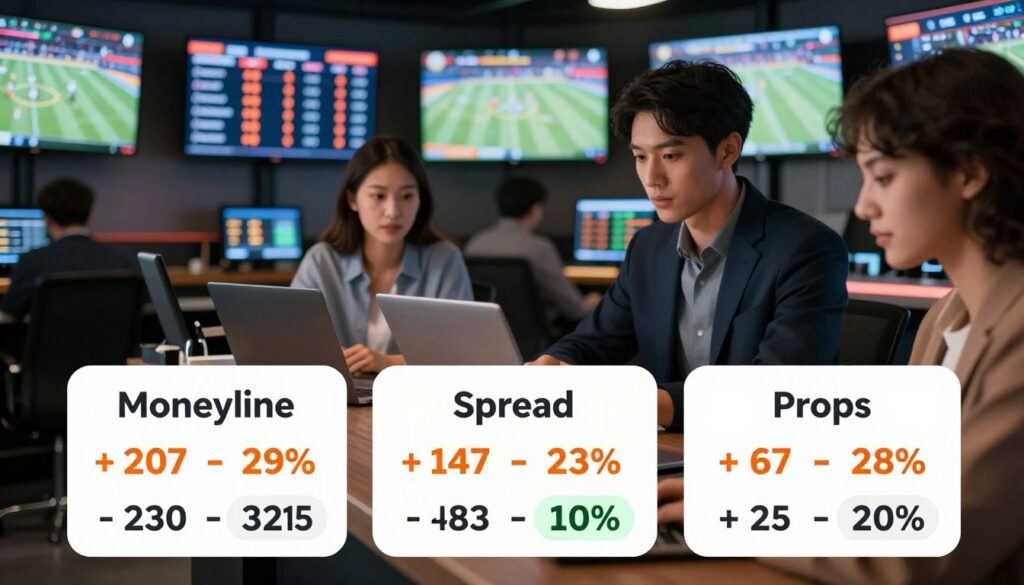
Moneyline Example: You’re betting on a baseball underdog. Book A has +195, while Book B offers +205. This ten-cent difference is huge.
A $100 bet at +195 gives a $295 payout, with $195 profit. Betting at +205 gives a $305 payout, with $205 profit. That’s an extra $10 in profit just by comparing odds.
Point Spread Example: In the NFL, the Saints are favored by 3.5 points (-110). You think they’ll win by a field goal. Shopping around, you find a book with Saints -3.0 (-120).
By paying extra -10 in juice, you get a strategic win. This edge is only seen by comparing multiple books.
Total (Over/Under) Example: The total for a college basketball game is 147.5 points (-110) everywhere. But one book offers 148.0 (-110).
If you bet on the Over, 148.0 gives you a half-point cushion. This increases your win chance for the same price. This difference is pure value, found through line shopping.
Prop Bet Example: Player props have big price differences. A star receiver’s yardage prop is Over/Under 64.5 yards (-115) at most places. But another book has it at 65.5 yards (-115).
If you think he’ll get 70 yards, the 65.5 line is better. Getting that extra yard is a big advantage. It shows why props need careful odds comparison.
Every example shows a key point. Prices and numbers vary. A small difference in a point spread, total, or price can change your expected value a lot.
Checking multiple books for every bet can lead to big savings over time. It turns small edges into significant gains.
Handling Limits and Verification
Sportsbooks limit sharp players to protect themselves. This makes using multiple books key for serious bettors. Betting limits are the max you can bet on a market.
If you always bet the best lines, you might get noticed. Your max bet could then drop a lot. This is called being “limited” and can hurt your chances to win.
The best way to fight this is to have multiple books. Betting on different sites means one limit can’t stop you. It also lets you find the best prices for your bets.
Verification is also very important. Always check your bet details before confirming. This is like checking product names and numbers when shopping.
Make sure the sport, event, line, and bet type are right. A small mistake, like choosing “1st Half Spread” instead of “Game Spread,” can cost you. Taking a few seconds to double-check saves money and stress.
Think of your betting accounts as a portfolio. Using multiple books helps avoid limits. Being careful with verification stops simple mistakes. Together, they help keep the edge you get from smart betting.
Record‑Keeping for Savings
Line shopping helps save real money. It’s common to track wins and losses. Profitable bettors also track the value of their lines.
Keep a record of the exact odds you accept. Compare them to the closing line at your main sportsbook. This shows your skill in securing better numbers.
This practice quantifies the “juice” you avoid paying. It measures extra value captured before a game starts. You see a direct financial benefit from your shopping discipline.
Create a simple log using a spreadsheet or an app like Google Sheets. Note the bet, the odds you got, and the market’s closing number. Calculate the difference.
Over time, your log reveals how much “juice” you saved. This data proves the strategies in this article work. It turns line shopping from a concept into a measurable profit center. Consistent tracking reinforces the habit for long-term success.
Leave a Reply