

Forget everything you think you know about picking winners. Profitable sports betting isn’t about guessing who will win the game.
It’s about finding value. This simple shift in mindset is what separates casual fans from serious bettors.
At its core, expected value is just the average amount you can expect to win or lose on a bet if you placed it thousands of times. A positive EV means you have a mathematical edge over the sportsbook in the long run.
For years, bettors relied on complex personal models to find this edge. This is a flawed approach. Your model’s probability might be wrong.
A smarter method uses the market itself as a guide. Tools like the market-based EV tool from BettingPros use odds from sharp, professional sportsbooks to establish a true market consensus.
Finding value then becomes simple. You just look for bets where the odds offered to you are better than this consensus price. The rest of this guide will show you exactly how to do that math, no advanced degree required.
Converting Odds to Implied Probability
Every betting odds set has a hidden number—the implied probability. It shows what the sportsbook thinks will happen. To find a betting edge, you need to understand this number.
Think of implied probability as the sportsbook’s guess at an event’s chance. The odds show the payout. The probability shows the risk. Learning to convert odds to probability is key to finding value bets.
American odds are common in the U.S. They have favorites (minus sign) and underdogs (plus sign). Each needs a different formula.
For a favorite, like -150, the formula is:
Implied Probability = Odds / (Odds + 100)
Use the absolute value of the odds. For -150, it’s 150 / (150 + 100) = 150 / 250 = 0.60, or 60%.
For an underdog, like +130, the formula changes:
Implied Probability = 100 / (Odds + 100)
So, +130 becomes 100 / (130 + 100) = 100 / 230 ≈ 0.4348, or about 43.5%.
Here’s a quick table of these conversions:
| American Odds | Type | Implied Probability |
|---|---|---|
| -200 | Favorite | 66.7% |
| +250 | Underdog | 28.6% |
| -110 | Close Favorite | 52.4% |
These numbers are the sportsbook’s guess, but there’s a catch. They include a profit margin called the “vig” or “overround.” If you add the implied probabilities for all outcomes in a market, the total will be more than 100%.
For example, a -110/-110 point spread implies a 52.4% chance for each team. 52.4% + 52.4% = 104.8%. The extra 4.8% is the sportsbook’s hold. It’s their profit margin.
Understanding this conversion is essential. It lets you see what the market thinks. Your goal is to find where the market’s probability is wrong. The gap between the implied probability and your own estimate is where your edge is.
Mastering this conversion is key. It turns abstract numbers into a clear picture of risk and reward. Once you see the probability behind the price, you’re ready to find value.
Estimating True Probability
Your personal guess of an outcome’s true chance is key to any expected value calculation. The odds from bookmakers show you an implied chance. But, it’s up to you to decide if it’s correct or not. The gap between your guess and the market’s is where your edge can be found.
Just going with your gut or rooting for your favorite team can lead to losses. To estimate well, you need a structured approach. Many start by looking at team strength, recent performance, injuries, and other factors like travel or motivation.
Tools like power ratings and matchup analysis are often used. For a more detailed method, some bettors rely on data-driven models. These models use past performance to predict future outcomes, aiming to eliminate emotional and biased thinking.

Topend Sports uses a scientific, five-step method. They use decades of athlete data, including speed, endurance, and skill. Their model forecasts outcomes based on these data, removing emotional bias.
Here’s a simple breakdown of this systematic analysis:
- Establish Baselines: Gather historical data on key performance indicators for all parties involved.
- Identify Correlations: Look at which metrics have historically predicted success in similar situations.
- Apply to Current Scenario: Use the current data for athletes or teams in the model.
- Adjust for Intangibles: Include qualitative factors like coaching changes or morale, but do so consistently.
- Output Probability: The model gives a percentage chance for each outcome, which is your “true probability” estimate.
This method helps you move from guessing to informed estimating. Your final number is based on data, not just guesses. It’s this number you compare with the odds.
The main goal is to find a difference. If your true probability is higher than the odds, you’ve found a positive edge. This gap is what you need for positive expected value. Without a systematic way to estimate true probability, finding your real expected value is hard.
EV Formula with Step‑By‑Step Examples
The core formula for expected value is simple. It compares your probability to the market’s. This math shows if a bet is good for the long run.
Here is the essential equation:
EV = (Probability of Winning × (Your Profit)) – (Probability of Losing × Stake)
Each part is important. “Probability of Winning” is your guess. “Your Profit” is what you could win. “Probability of Losing” is 1 minus your win chance. The “Stake” is what you risk.
Let’s look at two examples. We’ll figure out the expected value for each.
Example 1: A Positive EV (+EV) Opportunity
Your model says a team has a 55% chance to win. But the sportsbook thinks it’s only 40%. This difference might mean there’s value.
The odds for a 40% chance are 2.50. Betting $100 could win you $250. So, your profit would be $150.
Now, let’s use the formula:
- Probability of Winning: 0.55
- Potential Profit: $150
- Probability of Losing: 0.45
- Stake: $100
EV = (0.55 × $150) – (0.45 × $100) = $82.50 – $45 = +$37.50
This +$37.50 EV means you might win $37.50 on average for every $100 bet. It’s a good bet, even if the team loses this game.
Example 2: A Negative EV (-EV) Situation
Your model is less hopeful. It says the team has a 30% chance to win. But the market odds suggest a 50% chance.
The odds for a 50% chance are 2.00. Betting $100 could win you $200. Your profit would be $100.
Now, let’s calculate the expected value:
- Probability of Winning: 0.30
- Potential Profit: $100
- Probability of Losing: 0.70
- Stake: $100
EV = (0.30 × $100) – (0.70 × $100) = $30 – $70 = -$40
This -$40 EV is a warning. You might lose $40 for every $100 bet in the long run. It’s a bet to avoid.
| Scenario | Your Probability | Market Implied Probability | Odds | Stake | Potential Profit | Expected Value (EV) |
|---|---|---|---|---|---|---|
| High-Value Bet | 55% | 40% | 2.50 | $100 | $150 | +$37.50 |
| Poor-Value Bet | 30% | 50% | 2.00 | $100 | $100 | -$40.00 |
The table shows the power of comparing. A positive expected value means your probability is higher than the market’s. A negative value means the opposite.
Remember, EV is about long-term expectations. One loss on a +EV bet doesn’t mean the math was wrong. It means you trusted a process that pays off over time.
Bankroll Impact of +EV vs. ‑EV
The true power of +EV betting is seen in the steady growth of your funds over many bets. A single bet’s Expected Value is just a snapshot. But, your bankroll’s long-term health is the whole story.
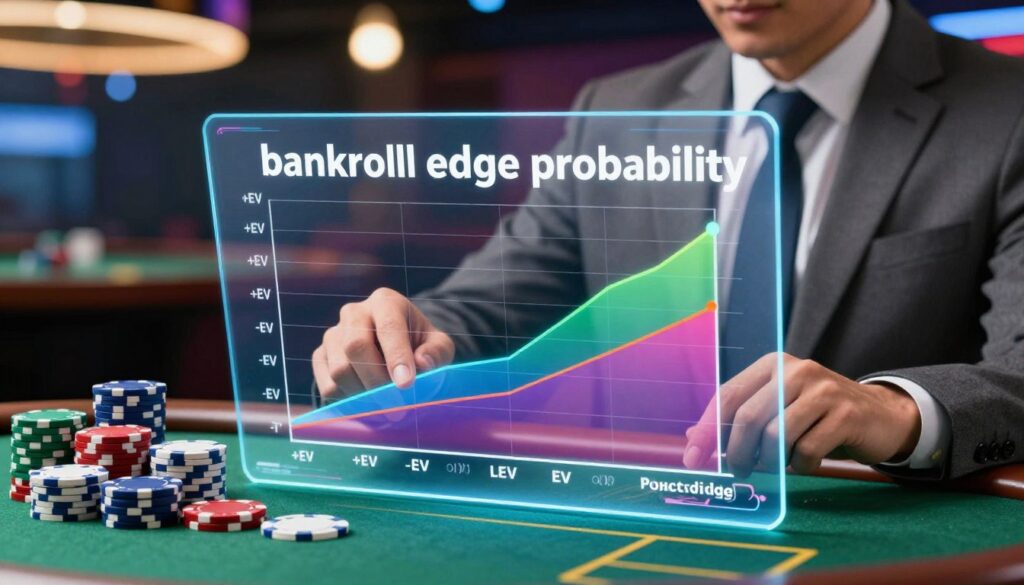
By consistently placing +EV bets, your bankroll gets a statistical edge over the bookmaker. This edge is like a gentle pull in your favor. Over time, it grows. You will have losing streaks, known as variance. But, with a positive edge, your money grows.
On the other hand, -EV bets slowly drain your funds. You might win sometimes, making you feel secure. But, each -EV bet, on average, takes away from your money. Even a 55% win rate on -EV bets can lead to losing everything. The key is not just winning, but which bets you win.
Experts say professional bettors often win less than 50% of the time. But, they make more money because they focus on +EV spots. They win less often, but their wins are bigger when they’re right. Choosing wisely, based on math, beats betting blindly.
To survive and let your edge work, you need to manage risk well. This means using two important ideas: confidence intervals and bet sizing.
Your EV calculation is just an estimate. Confidence intervals help you know how sure you are. Your bet size should match both the edge and your confidence in it.
A simple bet-sizing model works like this:
- Scale your stake with the edge: A bigger positive EV means a bigger bet.
- Reduce stakes with lower confidence: If you’re not sure, bet less, even if the EV looks good.
- Protect your capital during downturns: Don’t chase losses by betting more on weaker value opportunities.
This method turns math into a practical way to manage your money. You’re not just finding value; you’re also protecting your bankroll from swings while growing it.
| Betting Strategy | Win Rate | Average Odds | Average EV per Bet | Projected Result after 1000 Bets |
|---|---|---|---|---|
| +EV, Disciplined | 48% | +120 (2.20) | +2.5% | Bankroll Growth |
| -EV, “Gut Feel” | 52% | -110 (1.91) | -3.0% | Bankroll Erosion |
| Coin-Flip (No Edge) | 50% | +100 (2.00) | 0.0% | Break Even (Before Vig) |
The table shows a key truth. The strategy with a lower win rate but a positive edge grows wealth. The one with a higher win rate but a negative edge loses it. Learning about EV and implied probability is key. You can learn more about these and other essential gambling terms to strengthen your skills.
Your bankroll is a tool. +EV betting sharpens it. Scientific risk management lets you use it well without losing it. Together, they turn gambling into a disciplined way to grow your money over time.
Common Estimation Errors
Getting a positive expected value isn’t just about math. It’s also about avoiding common mistakes. Your edge depends on how well you estimate true probabilities. Even small errors can turn a good bet into a loss.
The Projection Model Trap is a big problem. Many bettors trust one model too much, whether it’s their own or someone else’s. These models often have wrong assumptions or missing data.
Using a broken model can make you think you know more than you do. It messes up your probability guesses and ruins any edge you thought you had. Always check your models against market trends and real analysis.
Psychological biases can also hurt your edge. They make you see value where it doesn’t exist. Here are three common ones:
- Public Bias: Betting on popular teams seems safe but raises odds. The crowd is often wrong.
- Recency Bias: You overvalue recent games. A team’s last win or loss doesn’t show their true strength.
- Action Bias: Feeling you must bet on every big game. This leads to betting without a clear edge.
Each bias leads to emotional, not logical, betting. You start to want certain outcomes to happen, not just look at the real probability.
To avoid these mistakes, stick to a strict, methodical approach. Recognize bias and have the willpower to step back. True expected value comes from objective analysis, not feelings or the latest trends.
Keep your edge by doubting your own guesses. Ask yourself: “Am I relying on one source? Am I following the crowd? Am I betting just to bet?” Honest self-reflection will keep your estimates accurate and your EV positive.
Free Tools & Practice Drills
Mastering value betting means moving from theory to practice. To make consistent profits, you need to sharpen your skills and use the right tools.
Tools like Betsheets, Betstamp, or Trademate Sports help you check your performance. They show if you got a market edge before it changed.
Getting accurate probability estimates requires good data. Sites like Pro Football Reference or the Topend Sports database offer stats. These help you build models and find a real edge.
Begin with practice drills. Try to calculate the implied probability for every NFL point spread one weekend. See how your estimates compare to the market’s.
Next, paper-trade a model based on a single rule, like home-team win percentage. Track its hypothetical EV for a month. This helps you learn to spot true value without risking money.
These steps turn the EV formula into a routine. You’ll learn to spot when market odds don’t match true probability.
Leave a Reply