

Imagine sitting at a velvet-covered table where every decision feels like moving a pawn in a high-stakes chess match. That’s the essence of this casino classic – part probability puzzle, part adrenaline rush. You’re not just hoping for lucky draws here; you’re negotiating with fate using math as your mediator.
New players often treat the game like a slot machine with cards, but that’s like bringing a butter knife to a gunfight. The real power move? Treating it as a Swiss Army knife of casino survival. I’ve watched countless rookies transform their gameplay by learning when to hit, stand, or double down – turning desperation into calculated swagger.
Think you can wing it? Let’s be real: even James Bond would’ve gone broke without a system. The secret sauce lies in memorizing patterns that tilt odds slightly in your favor. It’s not about counting cards or psychic predictions – just cold, hard probabilities dressed up in a tuxedo.
Ready to stop gambling and start playing? This guide strips away the mystique, giving you the tools to outthink the house. Because here’s the kicker: knowing how to play blackjack isn’t about avoiding losses – it’s about making the casino earn every dollar.
Introduction to Basic Strategy
Blackjack is like a recipe, and basic strategy is the key to success. It’s not about remembering every outcome. It’s about playing the odds like a mathematician who binge-watched every heist movie ever made. Using a blackjack basic strategy chart can cut the house edge to just 0.5%. This makes the game surprisingly fair.
What Is Basic Strategy?
Trying to play “Stairway to Heaven” without learning guitar chords is like playing blackjack without basic strategy. It tells you exactly when to hit, stand, or fold based on your hand and the dealer’s card. It’s like Taylor Swift’s precision in probability equations: brutally efficient and unbeatable.
Why It Matters for Beginners
New players often treat blackjack like a coin flip, but the coin is rigged. Without basic strategy, you’re donating to the casino’s holiday fund. It’s like your financial seatbelt—skip it, and you’ll crash faster than a TikTok trend. Casinos love players who “trust their instincts” because it’s profitable for them.
Mastering the blackjack basic strategy chart isn’t about becoming a robot. It’s about outsmarting the system with cold, hard math. Would you enter a rap battle without memorizing your lines? Exactly.
The Structure of Basic Blackjack Strategy
Blackjack strategy is more than math; it’s a game of strategy where cards are the pieces. It’s like solving Da Vinci’s Code, but with better chances and fewer dangers. Let’s explore the three main parts that make you a master of the game.

Understanding “Hard” and “Soft” Hands
Your hand is not just a number; it’s a unique character. A hard hand (no ace) is like your strict side, always following the rules. A soft hand (with an ace) is your wild side, ready to take risks.
A soft 17 is like your inner Bruce Banner, ready to burst into action. But, it can also lead to disaster if not managed well.
Dealer’s Upcard: What to Watch For
The dealer’s upcard is like their secret signal. A 6 upcard means they’re nervous. A 10 or ace shows they’re confident. Use this information like a Navy SEAL reading the terrain – it tells you how to play.
Review of a Typical Strategy Chart
Strategy charts are like the Dewey Decimal System for Blackjack – they’re essential but not exciting. Here’s how to use them:
- Left column = Your hand (Hyde or Jekyll edition)
- Top row = Dealer’s tell card
- Intersection = Optimal move (no overthinking required)
Learn this chart like your Netflix password. A tip: Print it, laminate it, and show it to dealers. It’s legal and can improve your chances.
Essential Moves: When to Hit, Stand, Double, or Split
Ever wondered why splitting 8s feels like preparing for winter? In blackjack, it’s your best defense against the dealer’s icy 10. Mastering these four moves transforms you from a confused rookie to someone who might actually get comped a drink. Let’s break down the plays that separate the “I’ll take another cocktail” crowd from the “I’ll have my winnings in cash” legends.
Most Common Situations Explained
Blackjack strategy isn’t rocket science—it’s more like knowing when to fold ’em in Texas Hold’em, but with better odds. Here’s your cheat sheet:
- Doubling down: Imagine betting your Starbucks budget on a perfect latte shot. Do this when you have 11 against a dealer’s 2-6. Instant adrenaline rush with 70% success odds.
- Splitting pairs: Got two 8s? Winter is coming for your 16. Split them like Jon Snow splitting armies—suddenly, two decent hands instead of one doomed total.
- Standing pat: When you’ve got 17+ and the dealer shows a 7-Ace? Hold steady. This isn’t the time for heroics.
Examples Using Real-Game Scenarios
Picture this: You’re at a Vegas table with $200 chips. Dealer shows a 6. Your hand? Two Aces. Do you:
| Your Move | Outcome A (No Split) | Outcome B (Split) |
|---|---|---|
| Action Taken | Stand on soft 12 | Split into two Aces |
| Dealer’s Hand | Reveals 16, draws to 20 | Busts with 23 |
| Result | Lose $200 | Win $400 |
Splitting those Aces turns disaster into domination. It’s like turning a losing Battle of Winterfell into two simultaneous Red Weddings for the house. Remember: Basic strategy isn’t about guessing—it’s about knowing the dealer’s Achilles’ heel (usually a 5 or 6 upcard) and attacking like a Lannister pays debts.
Mistakes Beginners Make
Blackjack strategy charts aren’t magic scrolls. They’re like IKEA instructions written by a sleep-deprived engineer. One misstep, and you’re staring at a wobbly bookshelf of losses. Let’s look at three rookie errors that turn smart players into casino buffet regulars.
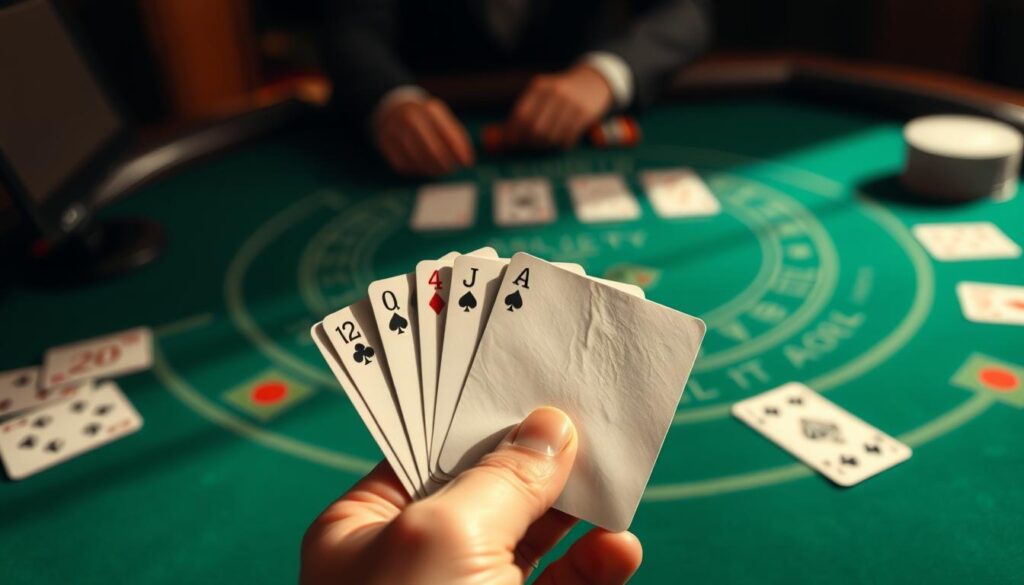
Misreading the Chart
Ever followed GPS directions straight into a lake? That’s what happens when players confuse “soft 18” (ace + 7) with a concrete hand. A Vegas newbie I watched split 10s against a dealer’s 5 – the blackjack equivalent of bringing a snorkel to a desert hike. Key takeaway: Strategy charts demand the focus of a Shogun episode binge-watcher.
Overbetting Hands
Insurance bets are the crypto bros of blackjack – flashy, mathematically dubious, and 99% likely to leave you poorer. Here’s the cold math: That “insurance” play you thought was smart? It carries a 7.7% house edge – worse odds than your 55% chance of getting a “u up?” text at midnight. Pro tip: When the dealer shows an ace, channel your inner accountant, not your inner gambler.
| Mistake | Real-World Analogy | Probability Impact |
|---|---|---|
| Splitting 10s | Returning a winning lottery ticket | +12% house edge |
| Taking insurance | Betting on Arizona snow | +7.7% house edge |
| Standing on soft 17 | Using dial-up in 2024 | +3.2% house edge |
Emotional Decisions vs. Strategic Ones
Chasing losses after three bad hands is like swiping right on every Tinder profile post-breakup – statistically desperate. I once saw a player double down on 15 because they were “feeling lucky,” turning a probable 40% loss into a guaranteed 100% disaster. Remember: The probability in blackjack doesn’t care about your gut feeling any more than TikTok cares about your sleep schedule.
Want to avoid becoming casino content? Treat strategy like your ex’s texts – analyze coldly, respond logically, and never, ever make decisions at 2 AM.
Practicing Your Strategy
Learning blackjack is like learning guitar. Even Hendrix needed time to get good. Basic strategy becomes second nature with daily practice.
Think of it as solving a crossword puzzle every day. It might feel repetitive, but it’s worth it when you get it right. Turn your kitchen table into a place where you can practice like a pro.
Free Online Simulators: Your 24/7 Card Sense Gym
Forget the fancy casino drinks and perfume. Online simulators are your fast-track to mastering blackjack:
| Tool | Best For | Realism Score | Cost |
|---|---|---|---|
| Blackjack Trainer Pro | Chart Customization | ★★★★☆ | Free |
| Casino Verité | Speed Training | ★★★★★ | $89 (lifetime) |
| WSOP App | Social Practice | ★★★☆☆ | Freemium |
High-stakes players say practice during your worst hours. This helps you get used to playing tired. If you can make smart decisions even when you’re not sharp, you’re ready for the big leagues.
Memory Hacks That Stick Like Chewing Gum Under Tables
Forget old-school memorization. Try these tips that work:
- The Coffee Order Method: Link “hit” decisions with your morning coffee. Your brain will soon connect the two.
- Hand Signal Karaoke: Use hand signals to practice your decisions. It’s a fun way to build muscle memory.
- Error Journaling: Keep track of your mistakes. Analyze them to learn and avoid making the same errors again.
Small-bet tables are not just for beginners. They’re where you can learn valuable lessons without risking too much. Practice until basic strategy feels natural, like breathing.
Advanced Options: When NOT to Use Basic Strategy
Basic strategy is your go-to for blackjack, but not always. It’s like wearing a tuxedo to the beach. There are times when following the chart too closely looks silly. Let’s look at when math and madness meet.
Side Bets: The Casino’s Candy Store
Side bets are like buying NFTs at a yard sale. They look flashy but are doomed to fail. Examples include:
- Perfect Pairs: Pays 25:1 if your first two cards match. Sounds great, but the house edge jumps to 6%+.
- 21+3: Combines your cards with the dealer’s upcard for poker-style payouts. The catch? You’re now playing two rigged games at once.
Basic strategy works for regular blackjack. But add these side bets, and you’re trying to beat a slot machine disguised as a card table.
Card Counting: MIT Genius or Modern Myth?
The MIT Blackjack Team made counting cards look cool. Today, trying to count cards is like trying to outsmart Alexa. Modern realities include:
- 6-8 deck shoes that reset constantly
- Automatic shufflers that negate penetration advantages
- Pit bosses trained to spot “card acting” better than Oscar judges
While counting can shave 1-2% off the house edge, most online systems are scams. Stick to basic strategy unless you have a PhD in probability and a poker face from Vegas.
| Strategy | Skill Level | House Edge |
|---|---|---|
| Basic Strategy | Beginner | 0.5% |
| Card Counting | Expert | -1% to 0% |
| Side Bets | Gambler | 5-10% |
Remember: deviating from basic strategy should be as intentional as a chess grandmaster sacrificing a queen. If you’re just “feeling lucky,” you’re not playing blackjack—you’re playing yourself.
Responsible Gaming and Continued Learning
Mastering blackjack is more than just memorizing charts. It’s about growing up with cards. Think of bankroll management as your 401(k) for gambling: it’s boring but vital. Strategy evolution means moving from YouTube tutorials to actual Jedi mind tricks.
Bankroll Limits: Your Financial Force Field
Your wallet isn’t Bruce Wayne’s – treat it with care. Here’s how smart players stay disciplined:
- The 5% Rule: Never bet more than 5% of your total bankroll on a single hand
- Loss Caps: Walk away when you’ve burned through 20% of your daily allowance
- Win Targets: Pocket 50% of big wins immediately (tax-free happiness!)
Need help sticking to limits? Our blackjack basic strategy money management guide turns willpower into math.
Strategy Resources: Beyond the Chart
Basic strategy is just the start. Here’s your advanced course:
- BlackjackInfo Forum: Reddit for probability nerds (bring your calculator)
- CV Blackjack Software: Simulate 10,000 hands before breakfast
- Professional Player Discord Groups: Where card counters argue about shoe penetration
Pro tip: Bookmark two resources max. Too much info turns strategy into chaos theory.
Conclusion
Think of blackjack basic strategy as your casino survival kit. It’s the blueprint that sets apart hopeful players from the calculated ones. It’s not about memorizing charts like you’re cramming for a midterm.
This is your Rocky Balboa stair-running montage, turning raw enthusiasm into disciplined execution. Imagine yourself as the Neo of card tables, dodging dealer upcards with Keanu Reeves-level focus.
Strategy Beats Wishful Thinking
Casinos bank on players treating blackjack like a slot machine with chairs. Don’t be that person. Those hard/soft hand decisions and split/double rules? They’re your lightsaber against the house edge.
Remember when Darth Vader underestimated the Death Star’s thermal exhaust port? That’s you ignoring basic strategy for “gut feelings.”
Start small with free trainers like Blackjack Apprenticeship’s drills or the Vegas Advantage app. Track your progress like a fantasy football stat sheet. Did your bankroll management prevent tilt-induced disasters? Did you ace those soft 18 vs. dealer 9 scenarios?
This isn’t gambling – it’s skill-building with better stakes than Wordle streaks.
True mastery means knowing when to break rules. Card counting works, but only if you’ve graduated from Padawan to Jedi. Until then, basic strategy remains your beskar armor.
So reshuffle those mental charts, set loss limits tighter than a Marvel movie runtime, and approach the table like it’s a chess match with free cocktails. The house edge shrinks when you play smarter, not harder.
Leave a Reply