
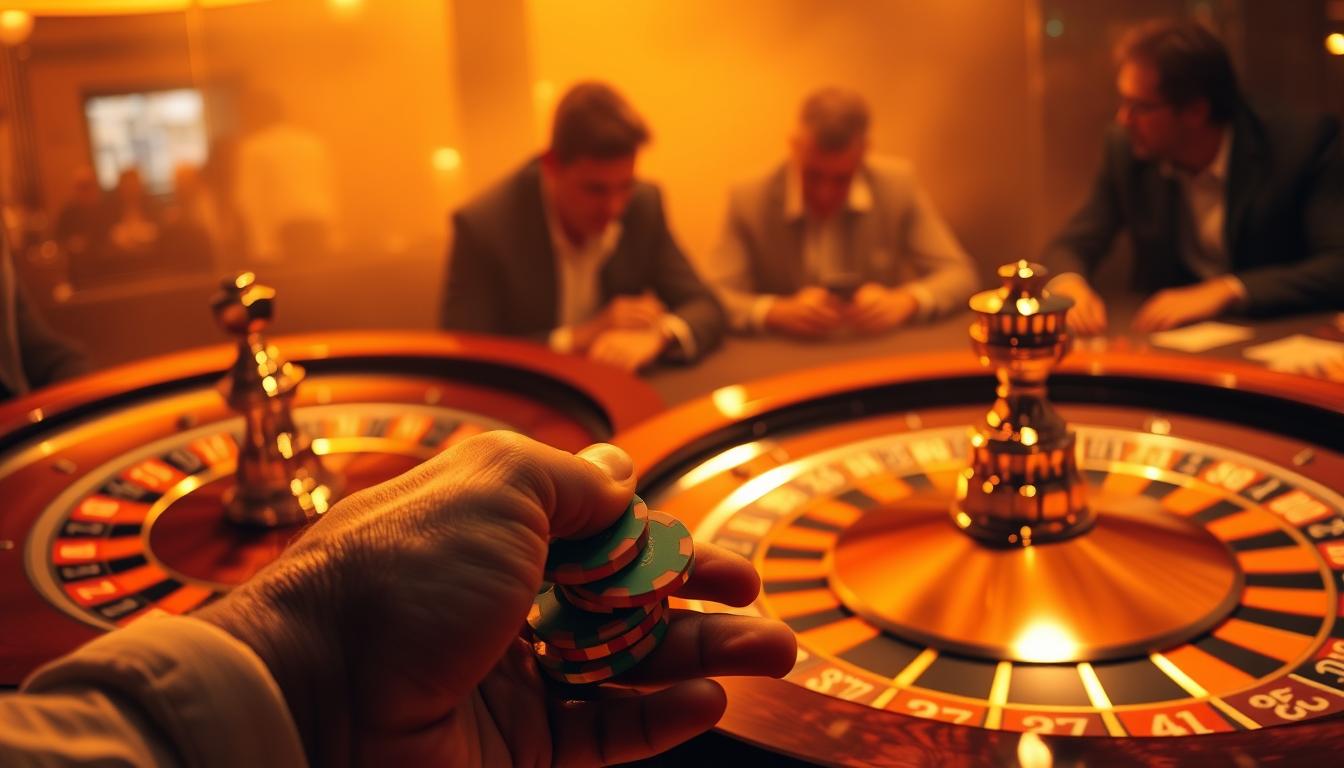
Imagine James Bond placing chips on roulette as the wheel spins. It’s like a hypnotist’s pocket watch. But, remove the fancy clothes and drinks, and you see a game of chance and numbers.
Every spin is a lesson in probability. The roulette wheel is more than just numbers. It’s a clever way for casinos to make money. The green zeros are key, making the game unfair for players.
Want to know the truth? American roulette has two zeros, giving the casino a 5.26% house edge. That’s a big advantage for the house.
Players use strategy to try and win. Inside bets offer big payouts, but they’re risky. Outside bets have better odds, but the house edge is always there.
Today’s players are more than just guessing. They’re using math to understand the game. The real battle is between chance and the house’s advantage. In roulette, the house always wins.
Roulette Basics: A Short History
Roulette’s story is like a French physicist’s midlife crisis. Blaise Pascal tried to make perpetual motion in 1655. But, it turned into a way for people to lose money.
Over three centuries, casino history shows how genius and greed meet. Often, the results are mathematically predictable.
From Lab Equipment to Green Felt
Pascal’s “perpetual motion machine” failed, but it created the roulette wheel. By the 1790s, Parisian aristocrats bet on these wheels. They turned science into high-society fun.
The game spread fast, reaching Monte Carlo by 1863. There, it became a symbol of luxury and loss.
The Transatlantic Rivalry
When roulette came to America, casino owners made it more profitable. They added a double zero, raising the house edge. This made Pascal’s game a “hope tax” for Americans.
| Feature | European Roulette | American Roulette |
|---|---|---|
| Number of Zeros | 1 (Single Zero) | 2 (Double Zero) |
| House Edge | 2.7% | 5.26% |
| Common Rules | La Partage (50% return on even-money bets) | No equivalent rule |
Today, triple-zero wheels show casinos learned the wrong lesson. They made “probability mullets” instead of improving Pascal’s design. These are disasters for your wallet.
Roulette Wheel Layout and Table Structure
Let’s explore the casino’s biggest trick. The roulette wheel is more than just a spinning ball of numbers. It’s a carefully designed puzzle. Are you ready to solve it?
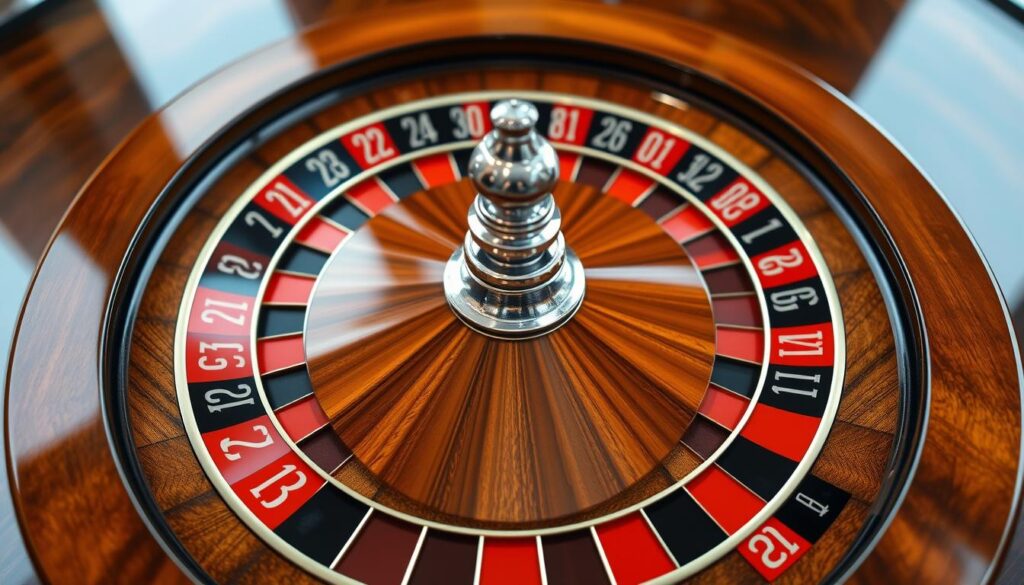
The Numbers, Colors, and Zeroes
Look closely at the wheel, and you’ll see its two sides. European wheels have 37 pockets, while American wheels have 38. The numbers are arranged in a way that seems random but isn’t.
Notice how numbers on the wheel and the betting table don’t match up. It’s like your music playlist never plays two sad songs together. This makes it hard to predict the outcome.
How Bets Are Placed and Handled
The table layout is like a map. It’s divided into different areas for different bets. This includes inside bets, outside bets, and border bets.
But here’s a twist: your chips are just markers, not real money. Dealers track them like the FBI tracks money transfers. This makes you focus on where you place your bets, not how much.
When the ball starts moving, the dealers work fast. They clear losing bets and pay winners quickly. They even keep a straight face when someone bets on unlucky number 13 again.
Types of Bets in Roulette
Roulette bets are like dating profiles – some scream “high-risk romance,” while others promise stable Netflix nights. Understanding this split between precision gambling and statistical comfort food separates casual players from those who’ve memorized Fibonacci sequences “for fun.” Let’s dissect the betting battlefield.
Inside Bets: The Sniper’s Playground
Inside bets are for thrill-seekers who enjoy whispering “all in” to single numbers. These high-stakes wagers target specific pockets:
- Straight-up: Betting on one number (35:1 payout)
- Split: Straddling two adjacent numbers (17:1)
- Street: Covering three numbers in a row (11:1)
- Corner: Four-number square (8:1)
The 5-number bet (0-00-1-2-3) is roulette’s Trojan horse – masquerading as strategic coverage while carrying a 7.89% house edge. It’s the casino equivalent of a “free trial” that auto-renews your losses.
Outside Bets: The Shotgun Approach
Outside bets are the sweatpants of gambling – comfortable, predictable, and statistically harder to embarrass yourself with:
- Red/Black (1:1)
- Odd/Even (1:1)
- High/Low (1:1)
- Columns (2:1)
- Dozens (2:1)
Choosing red because it matches your lucky socks? The wheel remains colorblind to your fashion choices. These bets survive on probability, not superstition.
| Bet Type | Payout | Win Probability | House Edge |
|---|---|---|---|
| Straight-up | 35:1 | 2.63% | 5.26% |
| Split | 17:1 | 5.26% | 5.26% |
| Red/Black | 1:1 | 47.37% | 5.26% |
| 5-Number | 6:1 | 13.16% | 7.89% |
The Mathematics of Mayhem
American roulette’s roulette payouts follow strict casino arithmetic – every payout ratio inversely mirrors its probability. That 35:1 straight-up win? It’s 35x your bet because you’re 35x more likely to lose. The green zeros are the house’s silent partners, skewing odds ever so slightly like a weighted grading curve.
Roulette odds reveal uncomfortable truths: even “safe” outside bets give the house a 5.26% advantage. It’s the price of admission for playing a game where physics and probability dance a carefully choreographed tango.
Game Flow: How a Spin Works
Imagine a roulette table as Mission Control during a moon landing – every second is precise. The croupier isn’t just spinning metal; they’re leading a dance of chance. Your chips are temporary guests in this dance.
From Bets to Bankrolls: The 45-Second Countdown
- “Place your bets” (T-minus 30 seconds): The dealer waves their hand like an orchestra conductor. This is your chance to arrange chips like chess pieces – straight-ups as pawns, splits as knights.
- “No more bets” (T-minus 5 seconds): The croupier becomes a human stop sign. Trying to sneak in late chips will get you the same reaction as trying to board a departing subway train.
- The spin (T-minus 0): The wheel becomes a metallic tornado while the ball defies gravity like a daredevil skateboarder. Think you can outrun physics? The house laughs at your attempt.
Dealer Protocol: More Structured Than a Swiss Watch
Croupiers follow protocols tighter than White House security detail. Their poker faces could fool a lie detector test, and their payout calculations would impress NASA engineers. Here’s how their actions unfold:
| Phase | Dealer Actions | Player Rules |
|---|---|---|
| Betting | Verbal cues, chip verification | Stack neatly or face side-eye |
| Spinning | Precision wheel launch | Hands off the table – this isn’t Times Square on New Year’s Eve |
| Payouts | Marker placement → Losers swept → Winners paid | Don’t reach until transactions complete |
The payout sequence follows strict logic: first, the marker points out the winner, then the dealer removes losing bets. Only then do winners get their chips back. Touch your chips mid-process, and you’ll see why dealers have faster reflexes than Olympic fencers.
Roulette Etiquette and Tips
Learning roulette is more than just guessing red or black. It’s about knowing the rules that make you stand out. Think of the table as a chessboard. Your position and timing are as important as your bets.
The Geometry of Advantage
Standing at a roulette table is like playing Tetris. Number bettors should sit near the wheel. Outside bet fans do better near the edges. Stay away from the dealer’s elbow to avoid getting hit with a drink.
The Casino Stopwatch
Betting on time is like airport security. Dealers won’t let you place bets once the ball starts falling. Betting late is like losing your free buffet shrimp – it’s not worth it.
Chip Forensics 101
Touching chips after a spin is like stealing your neighbor’s cake. When the ball lands, your chips are off-limits until the payout. Disagree with a result? Act like a lawyer, but the floor manager is the judge.
Casinos have more cameras than a true crime show. A small chip move can be misinterpreted quickly. Play wisely, stay calm, and let the wheel spin.
Playing Smart and Avoiding Pitfalls
Roulette isn’t a democracy. The house always campaigns harder. Think of the wheel as Wall Street’s rowdier cousin – it’ll take your money through perfectly legal math while making you feel like you’re having fun. Your mission? Play the game without becoming its pawn.

The House Edge: Casino’s Sneakiest Tax
That green zero isn’t just decorative – it’s a financial instrument. American roulette’s 5.26% house edge means casinos skim $5.26 from every $100 you bet. European wheels (single zero) drop this to 2.7%. “But I’ll just play short sessions!” Nice try. The edge works like reverse compound interest – your losses grow exponentially while the casino’s profits compound.
Let’s murder a myth: Martingale systems. Doubling bets after losses works about as well as trying to extinguish fire with gasoline. Lose six straight $5 bets? You’re suddenly risking $320 to win $5. Even Bond villains get better odds.
Bankroll Management: Your Financial Force Field
Treat your gambling fund like a VIP guest list – exclusive and non-negotiable. Here’s the blueprint:
- Coffee money, not car payments: Your daily stake = what you’d spend on artisanal lattes
- Session limits: 50% of total bankroll max per sitting
- Walk-away triggers: 30% up? Cash out. 50% down? Exit stage left
| Strategy | Short-Term Play | Long Sessions |
|---|---|---|
| Bet Size | 1-2% of bankroll | 0.5-1% of bankroll |
| Win Goal | 20% increase | 10% increase |
| Loss Limit | 25% decrease | 15% decrease |
Remember: The real jackpot is leaving with stories, not debt. Play like you’re investing in entertainment, not retirement. After all, even Oceans 11 had an exit strategy.
Free Play and Practice Options
Learning roulette without spending your rent money is like getting flight training. You practice on virtual wheels until you’re ready for real casino action. Today’s online roulette sites offer tools as sharp as a croupier’s skills. They’re perfect for practicing before you hit the real casino.
Reputable Online Simulators
Platforms like Bovada and BetMGM are like Wall Street for pretend money. Their RNG systems mimic casino physics so well, you might think digital players talk about “cold tables”:
- Bankroll sandboxes with $10k play money defaults
- Bet pattern tracking that’s more detailed than FBI profilers
- Speed settings faster than a caffeinated dealer
Studies show players who use these simulators remember strategies better than book learners. It’s like building muscle memory for your betting fingers.
Live Dealer Experiences vs. Computer RNG
Deciding between live streams and algorithms is like choosing between hologram concerts and Spotify. Live dealer streams add human touches, like a dealer who winks at your losing streak. RNG platforms, on the other hand, run as smoothly as a Swiss watch:
| Feature | Live Dealer | RNG Systems |
|---|---|---|
| Atmosphere | Real casino chatter | Your Spotify playlist rules |
| Speed | Human-paced (2 min/spin) | Instant (15 sec/spin) |
| Learning Value | Reading real table dynamics | Brute-force strategy testing |
RNG critics say “the algorithm’s rigged!” – a claim as silly as blaming your toaster for burnt bread. These systems are as secure as Fort Knox, checked by auditors as thorough as tax inspectors.
Conclusion: Ready to Place Your Bets!
Roulette for beginners isn’t just about luck. It’s about strategy. You’ve learned the wheel’s secrets: 37 pockets in Europe, 38 in America. Each pocket whispers different odds.
You’ve also learned about inside and outside bets. Now, the table is yours to play.
Casino confidence comes from knowing the game, not luck. The house edge isn’t your foe if you play smart. The green zero is just math.
Think of your bankroll like sourdough starter. Feed it wisely, and don’t bet more than you can afford to lose.
Sun Tzu would have been great at roulette. His advice? Know the wheel, the edge, and your limits. Practice on DraftKings’ free tables or FanDuel’s live dealers.
Remember, the ball doesn’t remember its last landing. But your bank statement will.
You’re in the 10% who know martingale systems fail fast. Use this knowledge to your advantage. The real win is outsmarting yourself, not just the wheel.
Place chips like you’re signing contracts. Spin like you’ve already won. The casino is waiting, but you’re leading the way.
Leave a Reply