

Knowing how your business does is key to reaching your goals. Betting is the same. Making choices based on facts, not just guesses, is what makes winners.
Good businesses don’t just wing it. They watch their numbers closely and act on them. This careful approach is your secret to making money over time.
Your main tool is a bet tracker. It’s where you record every bet, odds, and result. This method is like the bankroll management used by experts.
For those checking out tipster services or managing customers, knowing Customer Lifetime Value (CLV) is vital. It turns numbers into a clear view of long-term value.
This detailed tracking is not just busywork. It’s the base for getting better. It helps with effective KPI reporting and monthly reviews that lead to growth.
Building a Google Sheet Template
Forget scattered notes and mental math. A Google Sheets template is your single source of truth. It turns raw betting activity into structured, analyzable data.
The right template automates the heavy lifting. It provides a clean, consistent record for deeper analysis. This is your foundational data layer.
Every effective betting log needs these core columns:
- Date: When the bet was placed.
- Event: The specific game, match, or contest.
- Market Type: The bet type (e.g., Moneyline, Point Spread).
- Stake: The amount wagered.
- Odds: The price at which the bet was placed.
- Outcome: Win, Loss, or Push.
- Profit/Loss: The financial result of the bet.
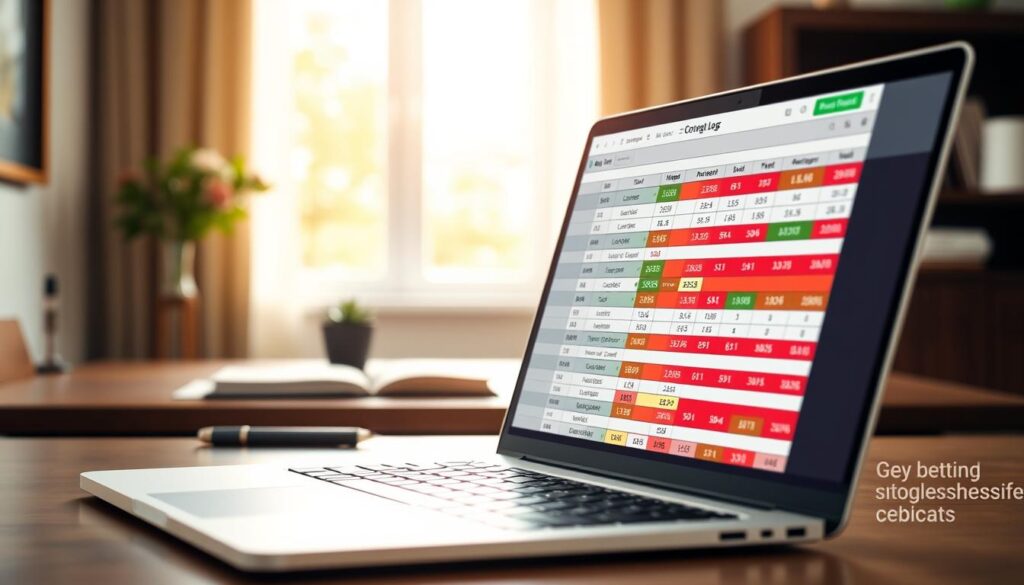
With this structure, you can move from simple recording to intelligent tracking. The real power comes from automated Key Performance Indicator (KPI) calculations.
Here is how a few sample entries might look in your template:
| Date | Event | Stake | Odds | Outcome | Profit/Loss |
|---|---|---|---|---|---|
| 10/26 | Team A vs. Team B (ML) | $50 | +150 | Win | $75 |
| 10/26 | Team C -3.5 | $100 | -110 | Loss | -$100 |
| 10/27 | Player X Over 2.5 Goals | $75 | +200 | Win | $150 |
Use formulas to calculate your vital stats automatically. A SUM formula can give you total profit/loss. Your ROI (Return on Investment) is (Total Profit / Total Stake) * 100.
Your hit rate, or win percentage, is (Total Wins / Total Bets) * 100. Seeing these figures update live is transformative.
This automated approach creates a reliable data set. Professional business intelligence tools, like Looker Studio, prize this kind of clean, integrated data. Looker Studio connects seamlessly with Google Sheets, allowing you to build dashboards from your log.
A well-constructed template does more than record history. It sets the stage for insightful monthly reviews and confident decision-making. Your data is now organized and ready for interpretation.
KPI Targets & Interpretation
A KPI is just a number without a benchmark. It’s the target that gives it meaning and purpose. First, you collect data. Then, you set clear goals and understand the results.
Continuous analysis helps you spot trends and make informed decisions. You need to know both your target and actual performance. This turns your log into a dynamic scorecard.
Realistic yet ambitious targets are non-negotiable for growth. They provide a standard to measure against. Let’s define core targets for betting performance.
| Key Performance Indicator | Target Range (Green Zone) | Contextual Interpretation |
|---|---|---|
| Return on Investment (ROI) | Positive (e.g., +5% or higher) | Any positive ROI indicates profitability. Sustained positive ROI validates your strategy’s edge. |
| Hit Rate | Varies by strategy (e.g., 55%+ for even-odds) | A high hit rate with very low odds may generate less profit than a lower rate with high-value bets. |
| Customer Lifetime Value (CLV) | 3x+ Customer Acquisition Cost | A healthy CLV for subscription models shows member retention and long-term value. |
Look at the table above. A positive ROI is the ultimate sign of a winning strategy. Your hit rate must justify the risk you take.

For instance, a 70% hit rate on bets with odds of 1.2 is less impressive than a 45% rate on bets with odds of 2.5. The latter likely delivers greater profit. Always interpret your hit rate alongside the average odds and stake size.
Similar to CLV, it’s not just a revenue figure. It measures how much a subscriber is worth over their entire relationship with your service. A rising CLV means you’re successfully keeping customers engaged and monetized.
To make assessment instant, adopt a traffic-light system. Express the status of each KPI as a color: Red, Yellow, or Green.
- Green: Performance meets or exceeds the target range. All systems are go.
- Yellow: Performance is within 10-15% of the target. Caution is advised. Monitor closely.
- Red: Performance is significantly below target. Immediate investigation and action are required.
This color-coding method, used in corporate reviews, gives you a dashboard-like view. You can see where you excel and where attention is urgently needed at a glance.
Regular review of these colored statuses is what makes KPIs useful. It transforms your spreadsheet from a passive log into an actionable performance scorecard. You’ll know exactly what excellence looks like for your operation.
Setting these targets is not about guesswork. It’s about using past data to set achievable, yet challenging, goals for the future. Your hit rate and CLV targets are your personal benchmarks for success.
Monthly Review Ritual
Starting a Monthly Business Review for your betting can give you 12 chances to learn each year. It turns your bet tracker into a key place for planning. You’ll stop, think, and plan carefully.
A Monthly Business Review (MBR) is a meeting to check how you’re doing against your goals. For bettors, it’s about comparing what happened to what you wanted. The aim is to use data to make smart choices.
The best way to do this is in three steps: Look Up, Look Back, and Look Forward. This method makes sure you cover all important parts of your strategy, analysis, and planning.
| Review Phase | Primary Focus | Key Questions to Answer |
|---|---|---|
| Look Up | Strategic Goals | Are we on track with our long-term bankroll and ROI goals? What’s our main goal for this quarter? |
| Look Back | Past Performance | What did our bet tracker and KPIs show us last month? Did we meet our targets? |
| Look Forward | Future Priorities | What actions will we take next month based on our analysis? What should we start, stop, or keep doing? |
Make sure your meeting agenda stays the same every month. This helps you stay on track and makes planning easier. Focus on three main things.
- Goals: Check your big strategic goals. This is your “Look Up” moment.
- Metrics: Look at the important numbers from your bet tracker. Check your win rate, profit/loss, and ROI against your goals.
- Projects: Choose specific projects for the next month. This could be trying a new betting system or improving your research.
This ritual makes you accountable every month. It stops you from just going through the motions. You own both your successes and failures.
The regular meetings are its biggest advantage. You get 12 chances a year to make things better. This turns luck into steady improvement.
By making this review a key part of your routine, you build a process that gets better over time. Your decisions become smarter. Your strategy stays focused and meets your financial goals.
How to Course‑Correct
Your bet tracker gives you the signs. The real challenge is knowing how to act. If ROI or hit rate turns red, you must act fast. Modern tools alert you in real-time through email, Slack, or mobile.
Ask yourself: “What’s being done to fix this?” Your detailed log has the answers. Find out the real cause. Was it bad luck, a mistake in value, or an emotional bet?
Fixing the problem is key. For a low ROI, adjust your betting amounts or pickier criteria. If CLV is down, rethink your long-term betting plan. Sometimes, the best step is to pause and rethink everything.
This approach builds a culture of growth, not blame. Your record-keeping system turns data into smart decisions. Your bet tracker is the key to ongoing improvement.
Leave a Reply